In Search Of A Grand Master
by
Master Kevin May
 Martial Arts has been a big part of my life since 1986. Since my first
beginning class, I have placed TaeKwon-Do ahead of all other activities
that before had taken up most of my time. Never before had I been in a
location where I could take advantage of learning a martial art form.
This training is always something I have taken seriously and look forward
to each and every class.
Martial Arts has been a big part of my life since 1986. Since my first
beginning class, I have placed TaeKwon-Do ahead of all other activities
that before had taken up most of my time. Never before had I been in a
location where I could take advantage of learning a martial art form.
This training is always something I have taken seriously and look forward
to each and every class.
Shortly after my third testing, our training changed dramatically.
Our organization dropped three-step and one-step training and added a lot
of pre-set drill type exercises to our testing requirements causing a
lot of mixed feelings among the members. Many friends and even some
instructors left the organization once these changes were put into place.
All of our training time was used to prepare for testing requirements.
Forms were still the main focus point of our training. Each Black Belt
Instructor taught the forms the way they had been taught. This differed
from one Instructor to the next. Our Master Instructor changed the forms
from time to time. Each Black Belt was allowed to interpret the forms
and make minor changes on their own. Often you would have three different
instructors teaching you your form three different ways. The student was
allowed to chose which of the three different ways they wished to
perform the form. This quite naturally caused a great deal of confusion
within the ranks.
As many members, including Black Belt instructors, left our club, we had
a severe shortage of instructors. I had been an intern since I was a
seventh gup, starting with assisting the beginning children's class
and eventually assisting in the children's advanced class. As a second
gup I would, on occasion, fill in for the beginning adult Instructor. As
a first gup I taught, along with Mr. Myers, the adult beginning class.
Shortly after becoming a black belt I was given the task of teaching
the adult intermediate class.
The teaching consisted of perfecting the many pre-set requirements which
included: Forms, Pattern Practice, Belt Combinations (different for each
gup level up to red belt), Three Beat Rhythm Practice, Six Beat Rhythm
Practice, Single Counter Sparring, Double Counter Sparring, Kicking
Drill (Front snap, crescent, reverse crescent, turning kick, hook kick
and side kick), Self-Defense (Three moves required and were the same for
all gup levels), and Free Sparring.
All of these testing requirements, except three simple self-defense moves
involved blocking, punching and kicking. In order to be ready to test
we had to spend all our training time working on these techniques.
With all the time spent perfecting these pre-set combinations and moves,
we were not spending any time learning to defend ourselves in a way that
would not seriously injure the person attacking us. Our free sparring
prepared us to block, punch and kick in order to defend ourselves in a
fist-fight. Many situations do not result in a fist-fight, however.
Many confrontations could be resolved without having to seriously injure
the aggressor. We were promoting people through the ranks who could not
defend themselves on the streets without causing serious or even
permanent injury to the attacker.
As family members and friends learned of my involvement in TaeKwon-Do, they
would say things like "Show me something" or "What can you do". All I
would be able to do is say, "How bad do you want me to hurt you?" I would
talk about becoming conditioned to seeing punches and kicks come at my head
and, without even thinking, be prepared to block and counter. Those counters would always
be a punch or kick to different parts of the body. This is very effective
if your intent is to physically damage the aggressor.
In March of 1989 I started a printing company located in Vicksburg,
Michigan, about 30 miles from my home. About ten months later I had to
give up teaching the adult intermediate class in Sturgis because of the
time required to get this business started and make sure of its success.
Over the next year I had a desire to start a club in Vicksburg, Michigan
and had many people from the area ask me to do this. As the printing
business grew, we leased a very large building and sub-leased part of it
to help pay for the lease.
One of our tenants was Ballards Weight Rack, a free weight power lifting
gym. John Ballard had asked me to start a TaeKwon-Do school and have
aerobics taught in the same room when not in use for martial arts.
I checked into the business requirements and decided to open my own club.
Many things had to be done to prepare this building for use as a dojang
for TaeKwon-Do. Finally, at the end of September of 1991, the construction
and painting of the room completed, I was ready to open the doors for
the first group of students.
Before I started the first class, I wanted to have a demonstration so
that those who were interested could see what they were getting involved
in before they signed up. I had flyers printed that announced the
demonstration as well as the starting times for the first classes.
To assist me with the demonstration, I invited members of the Union City
and Sturgis clubs to participate in a regular class situation. This way
those watching would see what they would be doing during a regular class.
This proved to be very effective and at the end of the demonstration
we had a question and answer session. This helped to assure the parents
that the instruction of their children would not be severe or harsh.
I also re-assured them their children would not be turned into
troublemakers and bullies, nor were they in any great danger of being
injured during a regular training session.
As Instructor of the Sturgis club I had no direct dealings with our
Master Instructor, nor did I have any knowledge of how other martial
arts clubs were organized; what other Master instructors allowed Head
instructors to do (ie. training, testing, financial arrangements to
split promotion fees, decisions to make major changes in any area, etc.)
 My experience with our Master Instructor was during testing only. At these
testings, we would be told what areas needed to be improved in general.
Sometimes we would be introduced to a new training procedure. Other times
those testing would be instructed by the Master Instructor to change a
technique in the middle of testing. This always caused concern to
instructors, like myself, who had been teaching this technique to
this student, the way we had been previously instructed to do so.
Other times instructors would
be reprimanded at the testing, in front of all the students, for teaching
techniques incorrectly. Now that I had my own club and faced many
decisions concerning what was best for my students, I began to have
serious doubts about how effective our training really was. In the
real world there are no second chances to get a technique right in order
to defend yourself.
My experience with our Master Instructor was during testing only. At these
testings, we would be told what areas needed to be improved in general.
Sometimes we would be introduced to a new training procedure. Other times
those testing would be instructed by the Master Instructor to change a
technique in the middle of testing. This always caused concern to
instructors, like myself, who had been teaching this technique to
this student, the way we had been previously instructed to do so.
Other times instructors would
be reprimanded at the testing, in front of all the students, for teaching
techniques incorrectly. Now that I had my own club and faced many
decisions concerning what was best for my students, I began to have
serious doubts about how effective our training really was. In the
real world there are no second chances to get a technique right in order
to defend yourself.
During this time Mike Houck was the Chief Instructor for both the Union
City and Sturgis Clubs. When I was organizing everything needed to start
the Vicksburg club, Mr. Houck and I worked together two to four times
per week and stayed in close contact concerning everything from organizing
the demonstration to ordering patches and other items needed for new
members. During our conversations the problems facing the clubs were
addressed and I discovered that quite a number of high ranking Black Belts
were also having problems with the direction our training had taken.
One of the original founding Black Belts had started doing some checking
into finding a new Master Instructor on his own and had been quietly
searching for over a year. This same type of search was also started by
Mr. Houck and Mr. Haskin, a second degree Black Belt from Union City.
A number of leads were developed and were checked into with serious
intentions of changing Master Instructor affiliations.
Many things were to be taken into consideration when examining a new
Master Instructor. Among these were:
- International ranking certificates. This was particularly important to
most of our Black Belts and was one of the advantages that was offered
by our existing Master Instructor. This did cause confusion among our
Black Belts because most of us were registered in Korea under the
Kukkiwon system even though none of us knew any of the Kukkiwon
style forms. One of our Black Belts had been in Maryland for a number of
years and while there went to a school that taught Kukkiwon forms.
They thought that he was a fraud because he did not know any of the forms.
I had always been told that our Master Instructor registered us with one
of the Internationally known organizations so that if we moved anywhere
else in the world that another club would recognize and accept our rank.
This however is not possible with the style of forms we are taught and
the style of TaeKwon-Do in which we are registered.
- We were interested in finding a Master Instructor who had a serious
interest in helping us to develop our skills to a much higher level.
We wanted someone that would be willing to personally teach us and take
a hands-on approach. Someone that would be accessible for training
seminars and also just to be there to answer questions as they came up.
This seems so simple, but it is something new to our organization.
We were not interested in a Master Instructor who only wanted our dues
and testing fees, but one who was genuinely interested in our club, our
students and to furthering the art of TaeKwon-Do.
- Consistency. This was something we had never known. Everything from
our forms to testing requirements had been changed on a regular basis.
Seminars with our Master Instructor, which were rare, were designed to
go over changes in our forms. Testing requirements for first, second and
third degree were different for each student that tested for these ranks.
Temporary belt promotions were more common than permanent promotions,
with these temporary promotions requiring the student to make arrangements
to meet with the Master Instructor to polish rough areas. This involved a
four and a half hour car drive, round trip, to spend one to two hours
working out and then having to pay for the lessons.
- Reasonable turn around time for receiving certification of rank.
Many Black Belt students had not received their certificates even two
years after they were given their permanent promotions. This was not
uncommon as many Black Belts in our organization had to wait even longer.
I personally had to wait from March to January to finally receive my
certificate.
- Organizational abilities. How well organized and how smoothly does the
new Master Instructor's organization operate? Were procedures written
down or were they orally conveyed and changed at random? Were goals
predetermined and explained with plans of action to achieve those goals?
Were fees for services in writing and were they subject to change without
any reason given?
- Free flow of information. Just to be kept informed of events that were
scheduled for the entire organization would be something new. What other
clubs were involved in, and a schedule of events that our members could
participate in, would also be a bonus.
- Back to traditional training. Most of the Black Belts wanted to return
to the traditional three-step and one-step sparring.
These are some of the most essential elements we were looking for in a
new Master Instructor. What we found when we began to question other
organizations took us by surprise. We had been living in the dark ages
and had no idea what was generally accepted and permitted by other
organizations. This confirmed our belief that it would be in our clubs'
best interest to look for another Master Instructor.
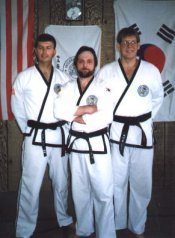
From left to right: Master Kevin May,
Grand Master Benko, Master Michael Houck
As the search continued, the name of
Grand Master James S. Benko came to us.
The initial contact was made and followed up with a package
outlining much of the organization. We were impressed: First, from the phone
conversation, this appeared to be a legitimate organization to be
considered and second, by the quick and professional manner the phone
conversation was followed up with the literature we received.
As soon as Mr. Houck saw that video tapes were available, a number of
them were purchased immediately. Among these tapes were the videos showing
the first ten forms. You cannot believe what a treasure this is to a club
that cannot even get two Black Belt Instructors to agree on all the moves
of a particular form. The video, TaeKwon-Do: Phase One, introduced
us to a few new stances, punches and blocks. During the Forms presentation
portion of the Phase One video, Grand Master Benko would explain different
points to consider for each form. During one of the forms, the statement
was made, that all students should be performing the forms the same way, and
that the forms would never be changed. I believe the direct quote is,
"These forms should be the same two thousand years from now".
Is it possible that other organizations do not change their forms from
year to year? It seemed that we had found an organization that not only
didn't change the forms, but insisted that they not ever be changed in
the future. This was very exciting news to us and only fueled our desire
to know more about this Grand Master Instructor.
The second tape that just really overwhelmed us was the
Unarmed Self-defense video. This tape began to show in detail and slow motion
how to use joint locks in different situations. There was more self-defense
techniques taught on this tape than I had been shown in over six years
of TaeKwon-Do training. The tape showed how an aggressor could be subdued
and controlled without causing any serious or permanent injury. This is
exactly the kind of techniques I had continually asked about all during
my training (all through the gup levels and even as a Black Belt).
I was always told, we would get to that type of training later.
Here was an organization that included this type of training for all
levels.
We immediately began to study these moves and each one of us would
introduce a different technique when we got together and worked out in
our Black Belt classes. I think all of our Black Belts have expressed
that we feel like we are white belts again, when it comes to learning all
the self-defense we were being introduced to from Grand Master Benko.
This had never been part of our training. Now that we have begun to feel
more comfortable with the techniques, we are spending more of our class
time teaching these things to our students. This will give them many
options that they would never have received from training from our
previous Master Instructor. Armed with this knowledge, it is not
necessary to cause serious or permanent damage to another person unless
the situation calls for such action.
The TaeKwon-Do Phase Two video began to teach us why we move at certain angles and
how these angles can be used to our advantage. During the two-step and
one-step sparring segments many take-downs were demonstrated. Again,
this was an area of training that we had all been begging for further
instruction. Now we could see the technique for ourselves over and
over again until we could get it right.
All this information was being passed around from Black Belt to Black Belt.
Whenever two or more of us would meet, all we talked about was the tapes and
books, and how great they were to be available to us. The enthusiasm level
throughout our club was rekindled, as a natural response to all of the
instructors increased enthusiasm. Still, we had not yet made a decision
to change Master Instructors and we had not told any of the gup level
students that we were even thinking of making a change. We felt it would
not be in the best interest to tell everyone until a decision had been
made, just in case the decision would be to remain with our current
Korean Master Instructor. Still, many students could see changes being made in
our training sessions and began to suspect that something major was
about to happen.
The turning point came when a group of our senior Black Belts made a trip
to Lapeer, Michigan and met Grand Master Benko. I was to be one of these
Black Belts, but because of surgery to my jaw I was unable to attend. I
have never seen such an excited and impressed group of martial artists,
as the group that returned from Lapeer.
The first thought that always comes to my mind when I think of that
meeting, as relayed to me by those who attended, was the courtesy extended
to them by everyone there from the ITA (International TaeKwon-Do
Association). The workout they went through was very thorough and many
corrections were made to the forms. Grand Master Benko's demonstration of
nerve strikes and pressure points on Mr. Jack Houck is something we
all still talk about. The respect and self-control demonstrated by the
children during the class, that was in progress when they arrived, was very
impressive.
Above all was the patience and willingness to answer all questions
completely and honestly. Never before had a Master Instructor been
willing to just sit and talk about any subject that we would chose.
Since my first conversation by phone with Grand Master Benko I have
understood how easy it is to talk to him. What a great benefit it is to
have someone willing to listen and answer your questions with the many
years of knowledge that this man has. That knowledge is a treasure that
is now available to all of us since we have made the decision to join
the ITA.
My second degree testing has been put off for over a year for one reason
or another. I am very happy that I will be the first, from our group of clubs,
to test and hopefully be promoted as a Black Belt in the ITA. An ITA Black
Belt means so much more than a Black Belt from my previous organization.
Since we have begun to train with the new self-defense techniques, my
confidence level to defend myself on the streets has soared to new
heights. As I look at others who are Black Belts, I now make a mental
distinction between ITA Black Belts and other Tae Kwon Do Black Belts.
I now know the level of expertise that is required to obtain a Black Belt
in the ITA. So much more training and knowledge is taught that I cannot
help but make this distinction.
As Head Instructor of my own school, I now feel confident that I am
teaching my students to adequately defend themselves. They are given
options and taught how to determine how much force is necessary to take
care of a given situation. Books, video tapes and other materials are
available to assist them in their progress toward Black Belt and beyond.
This change in Master Instructor affiliation has been a very exciting
time for all of us. We have made our choice and we have chosen well.
Copyright © 1998-
James S. Benko and ITA Institute.
All rights reserved.
Top of Page
|