Korean Nunchaku
(Tahn Do Li Ga)
by
Grand Master James S. Benko, Ph.D.
When you hear of the word nunchaku, most people envision Bruce Lee, since he often used them in his movies.
He showed how the nunchaku could be used in Chinese Wu Shu (martial arts). The weapon is also part of many of the Okinawan styles,
and is also incorporated into Japanese Ryu's (styles). However, there are many who are totally unaware that the nunchaku is used in some
Korean Mu Do (martial arts).
Historical Background
There are two common names for the nunchaku in Korean. First, there is the term, "Ee Chul Bong” (Two-Section Stick), and the more appropriate name of, “Tahn Do Li Ga” (Short Flail).
The tahn do li ga was a farm tool used for threshing grain. Rice was collected in the fields and tied into bundles for easier carrying. The bundles were carried to where the rice was to be separated from the stalks. The bundles of rice were opened and placed on top of a screen. The tahn do li ga> was held in one hand and, with a fast flipping motion, struck against the rice stalks.
This action loosened the rice which would fall through the screen and was collected. The rapid spinning action of the tahn do li ga enabled the workers to quickly dislodge the rice from the stalks, thus making the collection of the rice much faster.
 The primary agricultural center of Korea is in the southwest portion of the Korean peninsula. In ancient times in Korea this region was part of the Kingdom of Baek-Je. It was mostly in this area of Korea where the tahn do li ga was refined, by necessity, into a defensive weapon.
The farmers of ancient Korea quickly realized the potential of the tahn do li ga as a defensive weapon when confronted by multiple unarmed or armed assailants. The tahn do li ga’s ability to be swung in circular defensive, and if necessary, offensive patterns, created an almost impenetrable defensive barrier. The flipping and snapping motions generated tremendous speed and power in the form of blocks and strikes, which could quickly disarm and/or disable an aggressor.
The tahn do li ga could be easily concealed. While not in use, the tahn do li ga was tucked in a jacket or pant pocket, or wedged in the farmer’s belt. When called upon to perform farming tasks, or to be used for defensive purposes, it could be quickly be brought into action. In addition, it could be hidden in plain sight. It was common for farmers to have such a farming tool, so it would normally go unnoticed.
Today, in many areas, it is illegal to carry a tahn do li ga. In some cases the person practicing with this weapon may be more dangerous to himself than to his opponent. It takes constant practice in order to execute tahn do li ga movements without injuring yourself. If you swing the weapon and fail to grab it on its return, you could be injured. Also, when attempting to flip up one of the handles, then strike it with the other handle to drive it into a target, this may also result in injury to the practitioner. When the handle strikes a practice target, such as a pole or tree, the handle may recoil and strike the person executing the technique.
Anatomy of the Ee Chul Bong
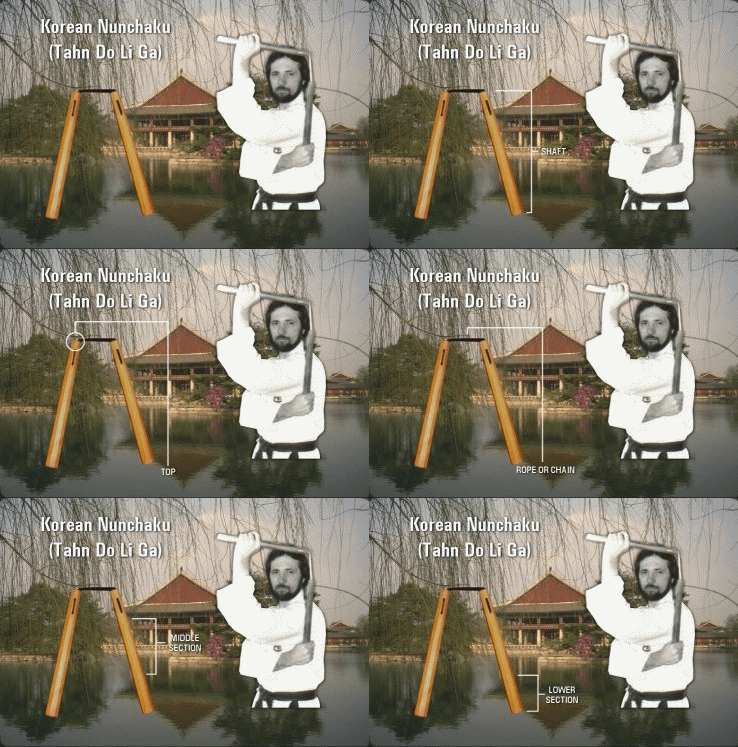 The two shafts, or handles, are usually made of a hardwood, such as oak. This gives the tahn do li ga both strength and flexibility. The cord which connects the two handles is primarily made of pat-chul (nylon rope) or sometimes a chain. Each of the sections range from ten to fourteen inches in length. The length of each handle should be the distance equal from the middle of the hand to just beyond the tip of the elbow.
Today tahn do li ga are usually manufactured in specific pre-specified lengths. It may be difficult for you to find a tahn do li ga which fits you correctly. In ancient times farmers constructed the tahn do li ga to suit their specific body proportions. If you are unable to find a “ready-made” version you may consider purchasing one which is too long and modifying its length. Or you may wish to adapt your movements to suit the length of the tahn do li ga you have purchased.
The cha-ru (handle) of the tahn do li ga is divided into three ku bun (sections): high, middle and low. The bottoms and tops of the tahn do li ga may be used in a jabbing, punching or striking motion. The handles may be used for blocking and striking, and the rope or chain, which holds the handles together, may be used to block, trap, pinch and choke an opponent.
Types of Tahn Do Li Ga
There are several different types of tahn do li ga. I shall address the most commonly known versions.
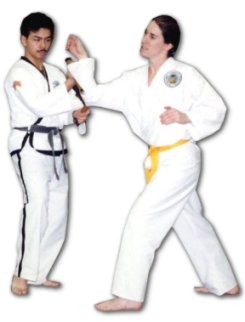 Tung-Gum Tahn Do Li Ga (Round Short Flail). This type is often used for training. It should be fairly heavy to permit the student to develop the swinging patterns used with this weapon. There are several “training” tahn do li ga available on the market today. The ones made from plastic, which are hollow, are good for students to learn the intricate whipping and swinging motions while limiting the chance of injury when practicing.
Pal-Jjok Tahn Do Li Ga (Octagonal Short Flail). This is the most commonly used version of the tahn do li ga. The eight sharp edges can be quite effective in both offensive and defensive situations. The edges aid in trapping, choking and pain-induced immobilizing techniques. When striking an opponent, the edges are capable of in inflicting greater damage than the rounded version of the tahn do li ga.
Jang-Tahn - Tahn Do Li Ga (Long-Short - Short Flail): This version is used primarily with whipping and swinging motions. The short section, which is the portion of the weapon used to strike an opponent, helps prevent the practitioner from striking his own hand when performing these movements. This version is rarely used to apply trapping or immobilization techniques. The short section does not permit the proper leverage necessary for the effective application of such techniques. It was sometimes used to strike opponents on horseback, knocking them to the ground.
Pan Ku-gi Tahn Do Li Ga (Half-Size Short Flail): This variation of the tahn do li ga consists of one rounded piece of wood cut lengthwise then attached to each other with a cord or chain at one end. This gave the appearance of the person carry this tahn do li ga to only be holding a stick, as the two halves held together look like one stick rather than two sections. The pan ku-gi tahn do li ga was easy to carry. However, it lacked the weight needed to generate any powerful strikes. It was used primarily to apply trapping an immobilizing techniques and could be employed to cut and slash an opponent with its edges with whipping and swinging motions.
Types of Blocks
For the martial artist the execution of many of the tahn do li ga blocks can be an extension of the blocks used in regular training. An upward block used in the martial arts employing the forearm can be applied with the tahn do li ga by placing one of the handles parallel to the forearm when blocking. Crossing the handles form an X-block.
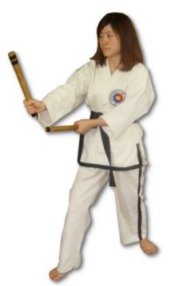 By using whipping and swinging motions, the tahn do li ga can be used to block and or deflect attacks. Blocks may be directed against the attacking arm or leg, or if the opponent is armed, against the weapon. Blocking against the hand holding he attacking weapon may result in disarming an aggressor if done properly.
When attempting blocks, distance, timing and commitment to your defensive movements can be crucial. When defending against an opponent who has a long-range weapon, such as staff or long sword, you may strike to disarm him, or quickly close the distance in order to trap the weapon and disable the opponent. If you hesitate, miscalculate the speed of the opponent’s attack, or fail to commit yourself to move in and control the opponent, then you may be unable to effectively execute your defense.
Always keep your distance from an opponent until you find a way to penetrate his defense. It is better to back away while blocking until an opportune moment presents itself for your block and counterattack. In such dangerous encounters you may only get one chance. When selecting your defensive strategy, choose wisely.
Training Methodologies
Here are several methodologies which can be used with the ee chul bong to defend
against both unarmed and weapon attacks. The following are the:
"Principles of Tahn Do Li Ga Defenses":
- Block the weapon.
- Re-direct the weapon.
- Srike the arm holding the weapon.
- Re-direct the arm holding the weapon.
- Strike the attacking arm.
- Re-direct the attacking arm.
- Strike body targets.
- Trap the attacking arm.
- Disarm the opponent.
- Apply chokes.
- Attack pressure point targets.
Let's take a look at each of these principles.
Block The Weapon:
The shafts of the tahn do li ga may be used to block the blade of a knife, a club,
or other weapon. It is important that the block be applied as close to the
opponent's hand, which is holding the weapon, as is possible. If you attempt
to block the end of a long weapon, his strike may overpower your block. The
end of a baseball bat which is furthest from the player's hand will generate
much more power that a section of the bat which is much closer to his hands.
Imagine trying to block the end of a baseball bat when it is swung full force.
So, position yourself so that you are able to block an oncoming force, arm,
club, etc., as close to its pivot-point as possible.
Re-Direct The Weapon:
If a downward attack with a weapon, such as a club or sword, is directed
toward you, you could step to the side to avoid the initial attack then, with
the tahn do li ga, strike or push the weapon in the direction it was initially
traveling. This would tend to off-balance the opponent allowing you the
opportunity to strike or disarm him.
Strike The Arm Holding The Weapon:
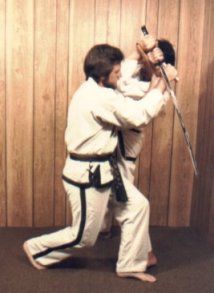 By striking the arm which is holding a weapon you could possibly disable
and/or disarm the opponent. The intensity of your strike will determine how
the opponent will react to your strike. Striking the arm which is holding the
weapon also includes other targets of the arm including, but not limited to,
the wrist, elbow, biceps, triceps, and forearm.
By striking the arm which is holding a weapon you could possibly disable
and/or disarm the opponent. The intensity of your strike will determine how
the opponent will react to your strike. Striking the arm which is holding the
weapon also includes other targets of the arm including, but not limited to,
the wrist, elbow, biceps, triceps, and forearm.
Re-Direct The Attacking Arm:
You can re-direct the attacking arm and maneuver the opponent into an
immobilization, submission, or throw. Re-directing the attacking arm may also
contribute to off-balancing the opponent, will create openings in his defense,
and may lead the opponent into a disarm technique.
Strike Body Targets:
Vital points of the body may be struck in order to render the opponent unable
to harm you. To strike these targets you must get close enough to the
opponent in order to make your strikes effective. You must be selective about
the targets you choose, for once an opponent is able to get close to you, he
shall be in a position to possibly grab you even after you strike him.
Strikes must quickly disarm an opponent or place him in a position where he is
unable to reach you.
Trap The Attacking Arm:
The tahn do li ga is excellent for applying traps. The shafts of the tahn do li ga are
used to exert pressure against joints and sensitive pressure points of an
opponent. By using leverage the tahn do li ga can greatly, if not completely,
immobilize an opponent no matter what his size. Traps are often used to
control an armed opponent while at the same time securing his weapon so it no
longer poses a danger to you.
Disarm The Opponent:
Disarms can be executed by striking the hand, arm, elbow or other portion of
the extremity which holds and/or controls the weapon. The tahn do li ga itself
may be used to apply pressure to disarm an opponent or as a lever to pry or
easily rend a weapon from the grasp of the opponent.
Apply Chokes:
The shafts and rope or chain of the tahn do li ga may be used to apply a wide variety of
choking techniques to an opponent. Chokes are extremely effective when
attempting to immobilize and control an opponent.
Attack Pressure-Point Targets:
The tahn do li ga may be used to exert force to
pressure points. These pressure points are nerves and sensitive areas of the
body which are extremely susceptible to pain. With the use of the tahn do li ga,
you can induce pain, paralyze portions of the body, and disable an opponent.
It is attacks to these areas of the body which help make tahn do li ga techniques
so effective against even the largest opponent even if he is armed.
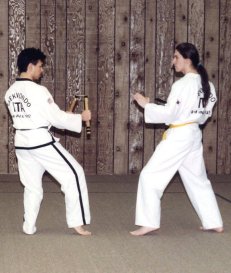
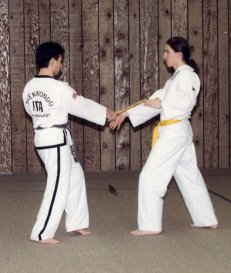
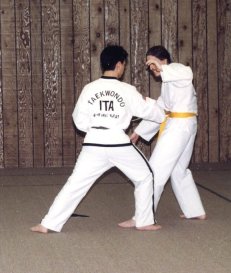
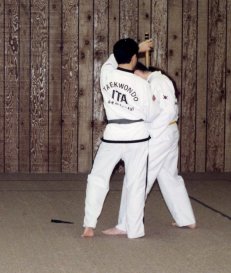
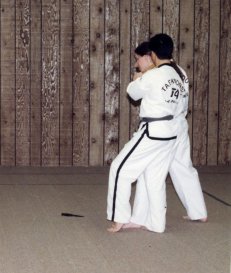
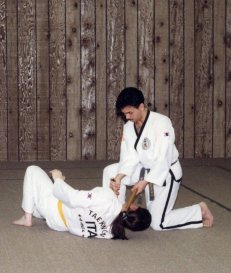
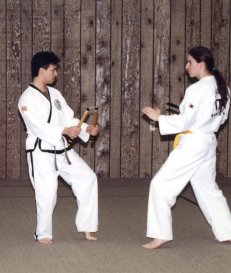
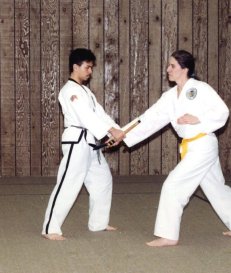
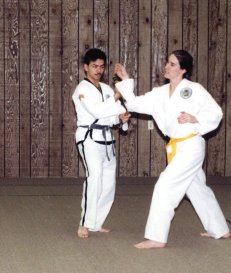
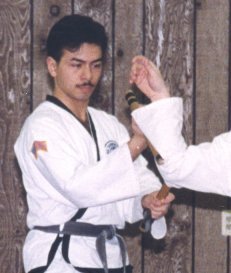
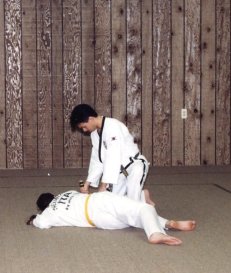
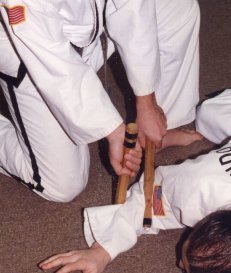
The following techniques are performed by Master James A. Benko one of his students.
|