| 
| 
|

| Korean Swordsmanship Shim Soo Do™ |

|
Top of Page |
 |
|
Korean Sword
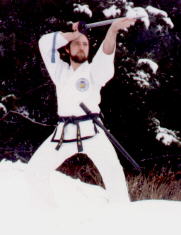
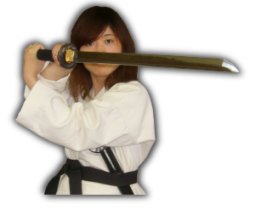
There are several different styles of Korean swordsmanship. One of the
major traditional styles is
Shim Soo Do™. Founded by Grand Master James S. Benko (10th Degree Black Belt Founder). The art of
Shim Soo Do™
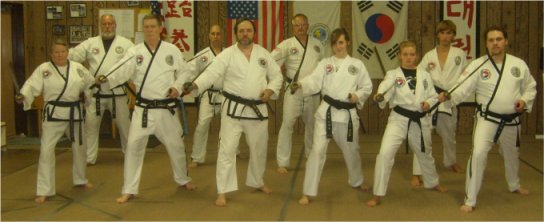
In part, Shim Soo Do™ consists of
kul-da
There are 17
hyungs
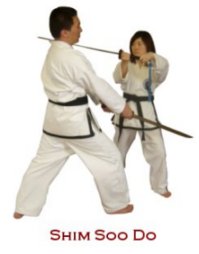
A na mu ui gum (wooden sword) is an integral part of sword training. The
student must first learn the proper movements of the
yul ki bon pe-da
The yul ki bon pe-da (10 basic cuts) are the foundation of sword practice. Students,
using the na mu ui gum (wooden sword), move up and down the training floor repeating each cut over and
over again. Each movement takes the student one step closer to perfecting
each technique.
The scabbard is slid into the belt, sharp edge of the blade facing upward. Some Korean sword schools require the blade face downward, but this is the "exception" and not the rule. The sword was kept in the belt in order to free the hands of the practitioner when not engaged in combat. When using two hands to grip the handle of the sword the right hand (for a right-handed swordsman), is against the hand-guard. The left hand is at the bottom of the handle. If the left hand were to grab further up on the handle the movements would lack both speed and power. Shim Soo Do involves much more than mere physical training of techniques. The Art also focuses on the development and cultivation of nae gong (inner power) and wae gong (outer power). Shim Soo Do also stresses shim gong (mental powers and development). All of these aspects of the Art are taught in order to help the student attain a deeper understanding of himself through the study of Shim Soo Do. This traditional Art of Korean swordsmanship also focuses on the development of the positive aspects of the exponent's character. The sword is not merely an extension of the practitioner's hand or movements. This is purely a physical interpretation and concerns itself with only techniques, which are only a small part of the complete Art. The individual who maintains this attitude toward Korean swordsmanship trains strictly on a physical level leading to low levels of personal character development. The study of the Art of Shim Soo Do™ is a continuous journey, not an attainable goal. Shim Soo Do™ practitioners commit and dedicate themselves to the idea that they will be students all of their lives, each and every day. The Art becomes much more than mere physical or mental training. To the practitioner it becomes a "Way" of life. In order to insure you are learning the complete Art of Shim Soo Do™, you will find Korean Swordsmanship DVDs in our on-line catalog. Grand Master James S. Benko guides you every step of the way through each aspect of the Art of Korean Swordsmanship, in these presentations. NEVER assume someone teaching Shim Soo Do™ is authorized to do so. ALWAYS contact Shim Soo Do™ World Headquarters to assure the instructor is not a shyster. His/Her credentials may be FRAUDULENT. Contact us via e-mail for verification. We shall take legal action to be sure such individuals are prosecuted. ALL certificates and membership cards are issued DIRECTLY from World Headquarters No individual or organization will ever be authorized to create or award ANY TYPE of certificate or card with the name Shim Soo Do™ on them. Only a FRAUDULENT instructor would attempt to do this. Beware of such BOGUS instructors. Any Shim Soo Do™ instructor who attempts such action automatically has his/her rank revoked.
|
|
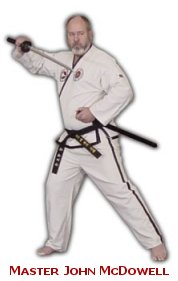
Once an individual has reached the black belt level he is referred
to as a
yu dan cha
The first seven ranks of black belt are awarded by performing physical and written examinations. Eight degree black belt and above are awarded by the founder based on several factors includiing, but not limited to, perfection of Shim Soo Do™ patterns and techniques, dedication to the Art of Shim Soo Do™ and parent organization, speading the Art of Shim Soo Do™, and quality of character. Shim Soo Do™ promotions are available from 10th Gup White belt to 7th Degree Black Belt. Individuals may advanced through the ranks using our exclusive training programs designed personally by Shim Soo Do™ Founder, Grand Master James S. Benko. Grand Master Benko performs all of the techniques required for promotion up to and including 7th Degree Black Belt. It is important to remember that no matter how long a person trains or what rank or title a person may achieve in Shim Soo Do™ he or she will always be a student.
|
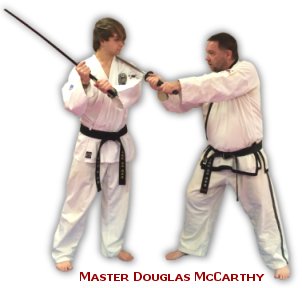 The Shim Soo Do™ belt ranking system is divided into two different classifications,
gups and dans. A student of Shim Soo Do™ who has not yet attained the
rank of black belt is referred to as a
The Shim Soo Do™ belt ranking system is divided into two different classifications,
gups and dans. A student of Shim Soo Do™ who has not yet attained the
rank of black belt is referred to as a
The 10 Basic Cuts Of Shim Soo Do
|
In Shim Soo Do™ there are 10 basic cuts. These "cuts" are the basis of all Korean Sword cuts and thrusts. Any other type of thrust or cut is merely a variation of these 10 basic cuts. The 10 Basic Cuts are practiced as 2-Handed and 1-Hand Cuts or motions. These are part of Shim Soo Do's promotional examination requirements. As with all Shim Soo Do techniques, the movements must be precise, and are therefore practiced on a regular basis in Shim Soo Do™ classes. The practitioner must be able to control even the most minute movement of the sword in order to insure exactness and precision. The 10 Basic Cuts are practiced both at normal speed and in a slow-motion to help insure the accuracy of the Cuts. The sword is worn with the sharp edge of the blade facing upward. The scabbard is thrust through the belt to hold it in place. The following is a chart giving not only the names of the Cuts, but the order in which they are taught and should be practiced:
|
At promotional examinations the student may, in addition to the hyung or hyungs
required for him to advanced to the next rank, be asked to perform any or all of
the hyungs up to the rank he is testing for. Therefore, students should practice
all of the hyungs they know, in addition to any new hyungs they may be learning.
Improper execution of a hyung shows the instructor that the student has not yet
grasped the correct movements of Shim Soo Do™. If the student's movement is
off by even a fraction of an inch it could result in serious injury to either himself
or those he is training with. Therefore, there is no room for error when training
with the blade.
Of all categories examined at a promotional testing, hyungs are the most critical
factor as to whether a student passes or fails the examination. If basic
movements are not learned properly, it will be evident in his hyungs. The
instructor will continue to assist the student in the development and cultivation of
correct form and technique through the practice of Shim Soo Do™ hyungs.
The following chart indicates the hyung(s) required for each rank to learn in
order to advance from one rank to the next. A 6th Gup would be learning Ji
Gum hyung in order to advance to 5th Gup. An 8th Gup would be learning Il
Kong-Gi and Ee Kong-Gi, hyungs before advancing to 7th Gup.
White Belt To Black Belt
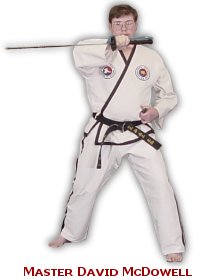 There are 17
hyungs
There are 17
hyungs  (patterns) which a student is required to learn before
attaining the rank of 1st degree black belt in Shim Soo Do™.
(patterns) which a student is required to learn before
attaining the rank of 1st degree black belt in Shim Soo Do™.
Name Of Pattern
Promotion
Il Kong-Gi Hyung (1st Air Pattern)
Ee Kong-Gi Hyung (2nd Air Pattern)
8th Gup To 7th Gup
Sam Kong-Gi Hyung (3rd Air Pattern)
Sa Kong-Gi Hyung (4th Air Pattern)
Oh Kong-Gi Hyung (5th Air Pattern)
7th Gup To 6th Gup
Ji Gum Hyung (Earth Sword Pattern)
6th Gup To 5th Gup
Il Pul Hyung (1st Fire Pattern)
Ee Pul Hyung (2nd Fire Pattern)
Sam Pul Hyung (3rd Fire Pattern)
5th Gup To 4th Gup
Sa Pul Hyung (4th Fire Pattern)
Oh Pul Hyung (5th Fire Pattern)
4th Gup To 3rd Gup
Il Pa-Ram Hyung (1st Wind Pattern)
Ee Pa-Ram Hyung (2nd Wind Pattern)
3rd Gup To 2nd Gup
Sam Pa-Ram Hyung (3rd Wind Pattern)
Sa Pa-Ram Hyung (4th Wind Pattern)
Oh Pa-Ram Hyung (5th Wind Pattern)
2nd Gup To 1st Gup
Mul Gum Hyung (Water Sword Pattern)
1st Gup To Black Belt
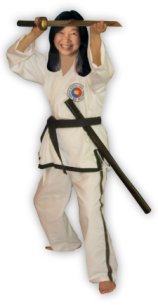 It is best to train directly under a "certified" Shim Soo Do™ instructor and
attend seminars conducted by Grand Master Benko, to insure you are receiving
the best instruction possible. However, as an additional method of training
to advance in rank, is by testing through the ETP (External Testing Program).
It is best to train directly under a "certified" Shim Soo Do™ instructor and
attend seminars conducted by Grand Master Benko, to insure you are receiving
the best instruction possible. However, as an additional method of training
to advance in rank, is by testing through the ETP (External Testing Program).





 Once you have been awarded your black belt in Shim Soo Do
you may apply to become a Shim Soo Do™ Head Instructor. This will enable
you to add Korean Swordsmanship to your school curriculum and teach
Shim Soo Do™ to your students.
Once you have been awarded your black belt in Shim Soo Do
you may apply to become a Shim Soo Do™ Head Instructor. This will enable
you to add Korean Swordsmanship to your school curriculum and teach
Shim Soo Do™ to your students.