
 






















 |

|
| Tae Kwon Do Patterns
Chon-Ji (Step-by-Step) |
|
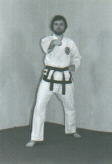
Chon-Ji is the hyung (pattern) required for advancement from 10th Gup White Belt to 9th Gup White Belt with Yellow Stripe. You "Yell" (YAH) on the first and last movement of Chon-Ji.
Click here.
Question and Response Sequence For Chon-Ji |
| Instructor: | Sound off! |
| Student: | Chon-Ji of TaeKwon-Do Hyung. |
| Instructor: | How many Movements? |
| Student: | 19. |
| Instructor: | How many different movements? |
| Student: | 3. |
| Instructor: | What does Chon-Ji mean? |
| Student: | Heaven and Earth. |
|
|
|
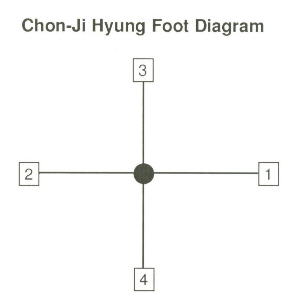
Pattern Numbering System
You shall begin all patterns by facing
number "4", with your back to number "3".
A black dot in the foot diagram indicates your
starting position. Since each starts
and ends in the same spot, the term "Choon
Bee "Ready Position" will refer to this
location in the foot diagram.
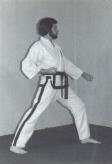
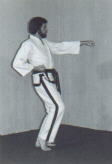
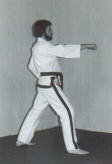
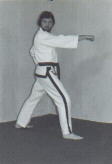
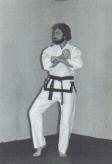
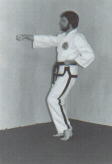
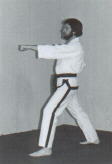
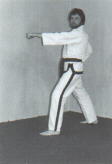
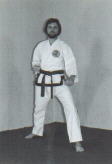
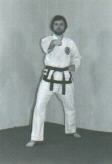
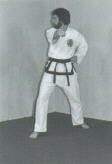
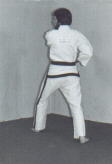
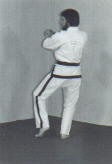
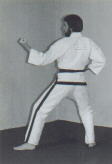
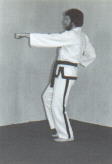
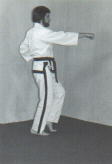
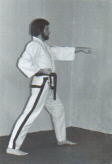
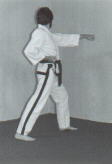
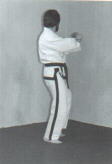
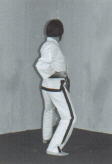
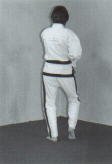
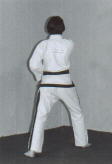
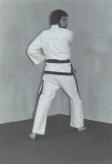
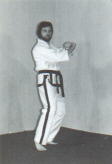
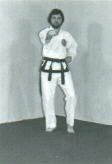
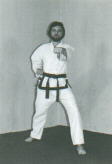
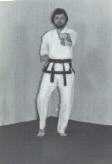
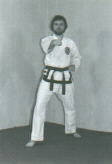
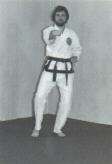
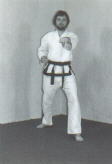
The word "Movement" followed by a number, is the
final position of one of the pattern's
movements. Here you will find a detailed
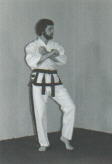
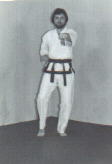
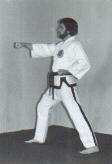
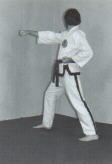
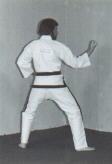
explanation of the movement. "Intermediate
Position" represents a photograph of a
step-by-step position from one movement to
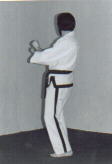
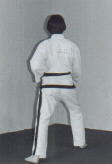
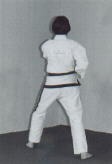
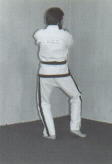
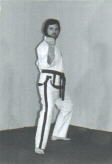
the next. The words "Other View Of
Photograph" followed by a number, provides
a view of the photograph number indicated,
from another angle. The purpose of
"intermediate positions" and "other views"
are to help clarify the exact body position of
a movement or how to correctly turn or move
in order to reach the final position of a
movement.
The word "YAH" will indicate you are to sound off (yell "YAH")
on that particular movement. When yelling
YAH is required, force all of the air out of
your body in one quick exhalation, through
your mouth, while yelling "YAH". There are
several reasons for yelling YAH. The yell
temporarily startles your opponent. It allows
you a better chance to absorb a blow should
the opponent attack you at the same time.
The yell also provides you with added power
through muscle tension and focus of internal
energy. When yelling YAH during a pattern,
be sure to tense your lower abdomen and
focus your attention on the area you are
attacking. This will provide you with added
speed and power.
At times a notation may be found
underneath a photograph preceded by an
asterisk. The notation usually refers to the
speed you are to perform a movement or
series of movements such as, "Perform this
movement in a slow motion", or "Perform
movements (number) and (number) in a fast
motion". You should adjust the rhythm
of your movements accordingly.
The word "Par Row" (Return to Ready
Position), indicates you are to return to the
same stance and hand position from which
you began the pattern.
|
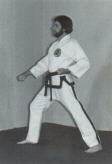
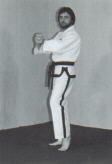
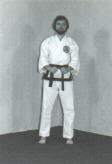 (Ready Position) |
 |
 |
 |
 |
 |
 |
 |
 |
 |
 Position |
 Position |
 |
 Position |
 |
 Position |
 Position |
 |
 |
 Position |
 Position |
 |
 Position |
 |
 Position |
 Position |
 |
 Position |
 |
 Position |
 Position |
 |
 Position |
 |
 Position |
 Position |
 |
 Position |
 |
 Position |
 |
 Position |
 |
 |
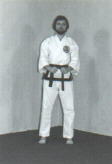 (Ready Position) |